





Basic structure of an X-ray tube
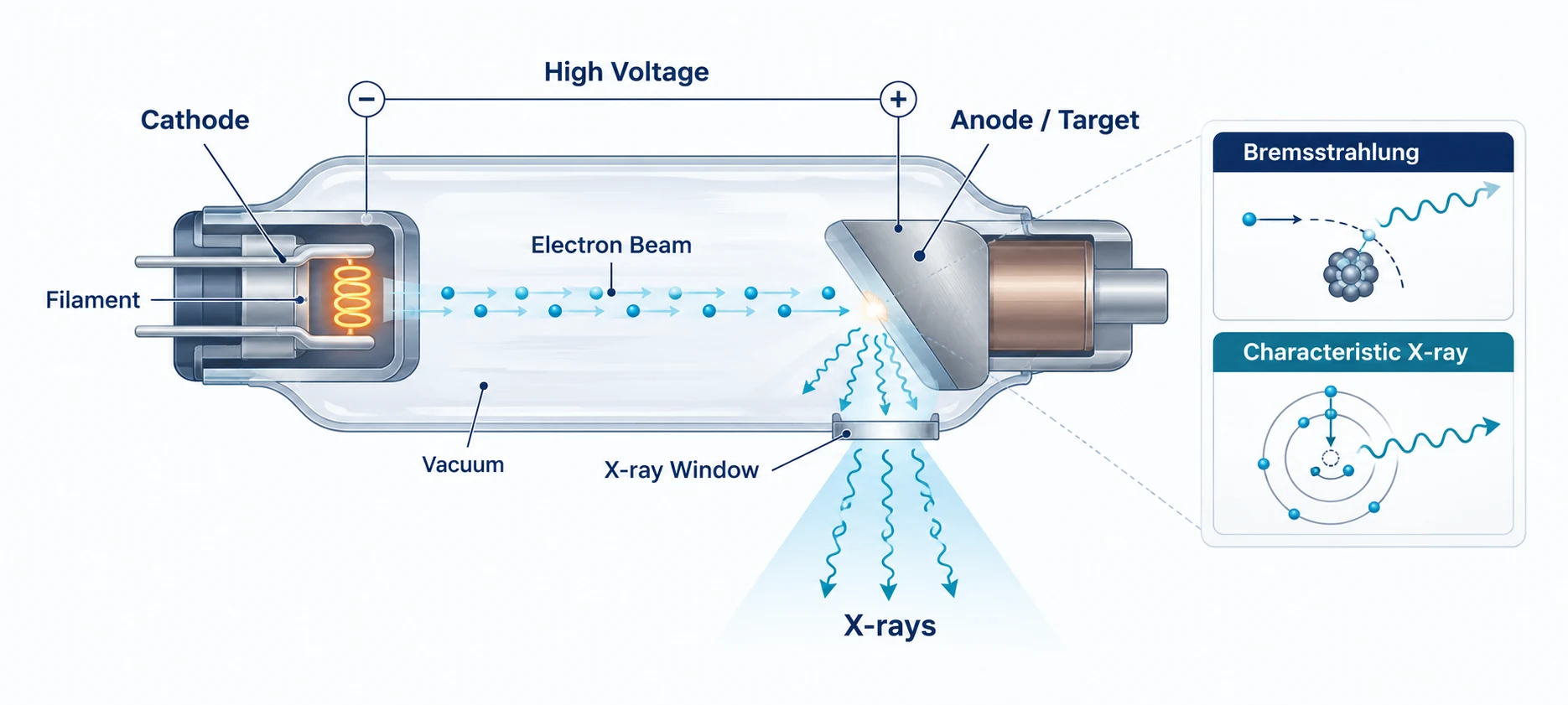
A typical X-ray tube contains a cathode and an anode inside a vacuum enclosure. The cathode includes a filament that emits electrons, while the anode contains the target that is struck by the accelerated electrons.
Heating the filament releases electrons through thermionic emission. The vacuum inside the tube allows these electrons to accelerate toward the anode without unnecessary collisions with air molecules.
Electron acceleration and interaction with the target
When a high potential difference is applied between the cathode and anode, negatively charged electrons are accelerated toward the positively charged anode. The tube voltage directly affects the kinetic energy the electrons can acquire and the maximum photon energy of the resulting X-ray spectrum.
When the accelerated electrons reach the target, most of their kinetic energy is converted into heat and a smaller fraction is converted into X-rays. Because of this thermal load, target material and heat management are important in X-ray tubes. Materials such as tungsten, with a high atomic number and high melting point, are widely used for targets.
Bremsstrahlung and characteristic X-rays
When an incident electron is decelerated or deflected by the electric field of an atomic nucleus in the target, part of its kinetic energy can be emitted as an X-ray photon. This process is called bremsstrahlung, or braking radiation, and it produces a continuous distribution of photon energies.
An incident electron can also remove an electron from an inner shell of a target atom, leaving a vacancy. When an electron from a higher energy level fills that vacancy, an X-ray photon with an energy corresponding to the difference between the two energy levels is emitted. This is called characteristic X-ray emission. The energies of characteristic X-rays are therefore related to the elements that make up the target.
What this means for an industrial X-ray source
The spectrum emitted by an X-ray tube contains both the continuous bremsstrahlung spectrum and characteristic X-rays produced by the target material. The X-ray beam used for inspection is then shaped by the tube window, filtration, and other components.
In industrial inspection, tube voltage, tube current, target material, filtration, and irradiation geometry all influence the characteristics of the X-ray beam. In general, tube voltage mainly affects the maximum photon energy and energy distribution, while tube current mainly affects the quantity of X-rays produced. The effects of kV and mA on practical inspection images are discussed separately in the next topic, “Understanding kV and mA.”
- Heating the cathode filament releases electrons through thermionic emission.
- The high voltage between the cathode and anode accelerates electrons toward the target.
- Bremsstrahlung and characteristic X-rays are generated at the target.
- Most of the accelerated electron energy is converted into heat, while a smaller fraction becomes X-rays.
- IAEA — Diagnostic Radiology Physics: A Handbook for Teachers and Students, Chapter 5: X Ray Production.
- NIST — X-Ray Transition Energies Database, Standard Reference Database 128.
- NIST — X-ray Bremsstrahlung Intensities from Elemental Targets, NBS Technical Note 1245.


