





What does a detector measure?
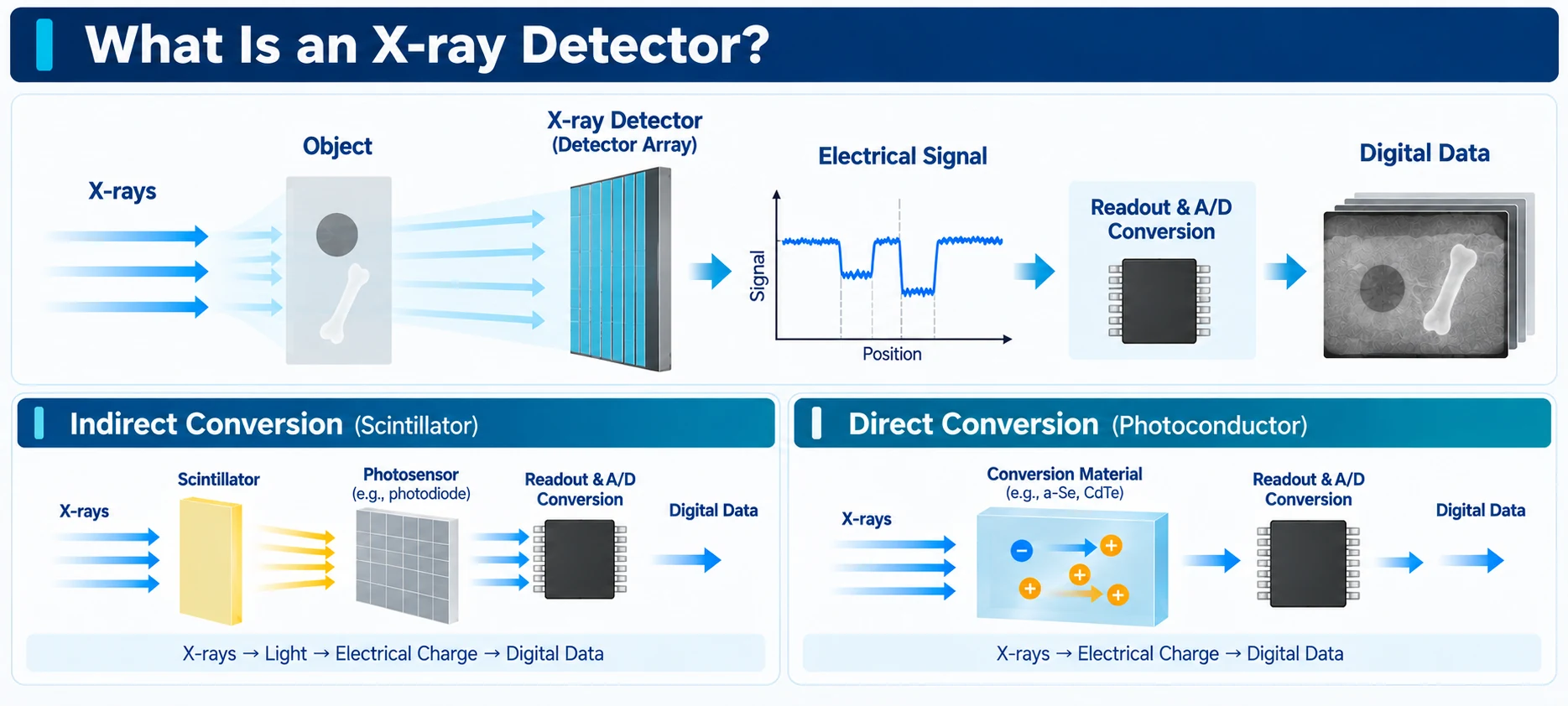
When X-rays pass through an object, some are absorbed or scattered and others are transmitted to the detector. Each detector element responds to the X-rays arriving at its position and generates a signal.
That signal can vary with the quantity and energy of the incident X-rays and with the response characteristics of the detector. In an ideal transmission image, position-dependent signal differences reflect differences in X-ray attenuation within the object and provide the basic information used to distinguish internal structures.
The basic role of a detector can therefore be summarized as Transmitted X-rays → Detection → Electrical Signal. The important point is that the detector does not directly complete the final X-ray image; it provides the measured data required for image formation.
How are X-rays converted into electrical signals?
Two representative solid-state detector conversion methods used in digital X-ray imaging are indirect conversion and direct conversion.
In indirect conversion, a scintillator converts incident X-ray energy into visible light, and a photosensor such as a photodiode converts that light into electrical charge. Readout electronics then measure the signal and acquire it as digital data. A representative flow is X-rays → Scintillator → Visible Light → Photosensor → Electrical Charge → Readout.
In direct conversion, X-ray energy is converted directly into electrical charge within a conversion material without an intermediate visible-light step. A representative flow is X-rays → Conversion Material → Electrical Charge → Readout.
These methods have different structures and characteristics. Specific detector architectures and their differences are discussed separately in 08. Understanding X-ray Detector Types.
How does a detector element measure spatial information?
A digital X-ray detector can contain multiple detector elements, each of which samples the X-ray signal at a particular spatial position. These position-dependent measurements provide the basis for spatial information in the final image.
A detector element and a final image pixel do not always correspond one-to-one. The way final image data are constructed can vary with detector architecture, sampling method, binning, interpolation, and system geometry.
A smaller pixel pitch can provide finer spatial sampling, but it does not always mean better image quality. Actual spatial resolution is influenced not only by pixel pitch but also by detector structure, signal spread in the conversion layer, system geometry, and other conditions.
How does a detector signal become digital data?
Signals generated by the detector can be acquired through readout electronics, conditioned as required, and converted into digital data through A/D conversion.
A general digital-detector signal chain can be understood as X-ray Detection → Electrical Signal → Readout / Signal Conditioning → A/D Conversion → Digital Data. The actual architecture and processing order can vary with detector design.
A line detector typically acquires one-dimensional line data in each acquisition. Repeating this process while the object moves can generate the data required to build a two-dimensional X-ray image. The detailed image-formation process is discussed in 05. How X-ray Images Are Formed; the key point here is that the detector generates the input data used for image formation.
Detector performance is not determined by a single specification
It is difficult to judge a good X-ray detector from a single specification. The quality of information available in practical inspection is influenced by signal, noise, spatial resolution, detection efficiency, acquisition conditions, and other factors together.
For example, a smaller pixel pitch can help with spatial sampling, but pixel pitch alone does not determine practical image quality. Likewise, even a high signal level may not provide the required inspection performance if noise is high or spatial resolution is insufficient.
A detector should therefore be evaluated as a balance of characteristics matched to the object and system conditions, not by one isolated number. Specific specifications such as pixel pitch, dynamic range, active length, and line rate are discussed separately in 09. Understanding Key X-ray Detector Specifications.
- An X-ray detector responds to X-rays transmitted through an object and generates measurable electrical signals.
- The detector does not directly create the final image; it provides measured data used for image formation.
- Representative solid-state conversion methods in digital X-ray imaging include indirect conversion and direct conversion.
- Detector elements sample position-dependent X-ray signals, but they do not always correspond one-to-one with final image pixels.
- Detector signals can be acquired as digital data through readout and A/D conversion, while the actual signal chain depends on detector architecture.
- Detector performance should be evaluated by considering noise, spatial resolution, detection efficiency, and inspection conditions together rather than pixel pitch or signal alone.
- IAEA — Diagnostic Radiology Physics: A Handbook for Teachers and Students, Chapter 7: Receptors for Projection Radiography.
- IAEA — Design, Development and Optimization of a Low Cost System for Digital Industrial Radiology, Radiation Technology Reports No. 2.


