





What are X-rays?
X-rays are a form of high-energy electromagnetic radiation classified as ionizing radiation. They have shorter wavelengths and higher photon energies than visible light. When X-rays interact with matter, some photons are absorbed or scattered while others pass through the material.
Industrial inspection uses the fact that X-rays are attenuated to different degrees depending on the material composition, density, thickness, and X-ray energy. The detector measures the X-rays transmitted through the object and converts them into electrical signals. The system then acquires these signals as digital data and processes them to form an image.
X-ray in the electromagnetic spectrum
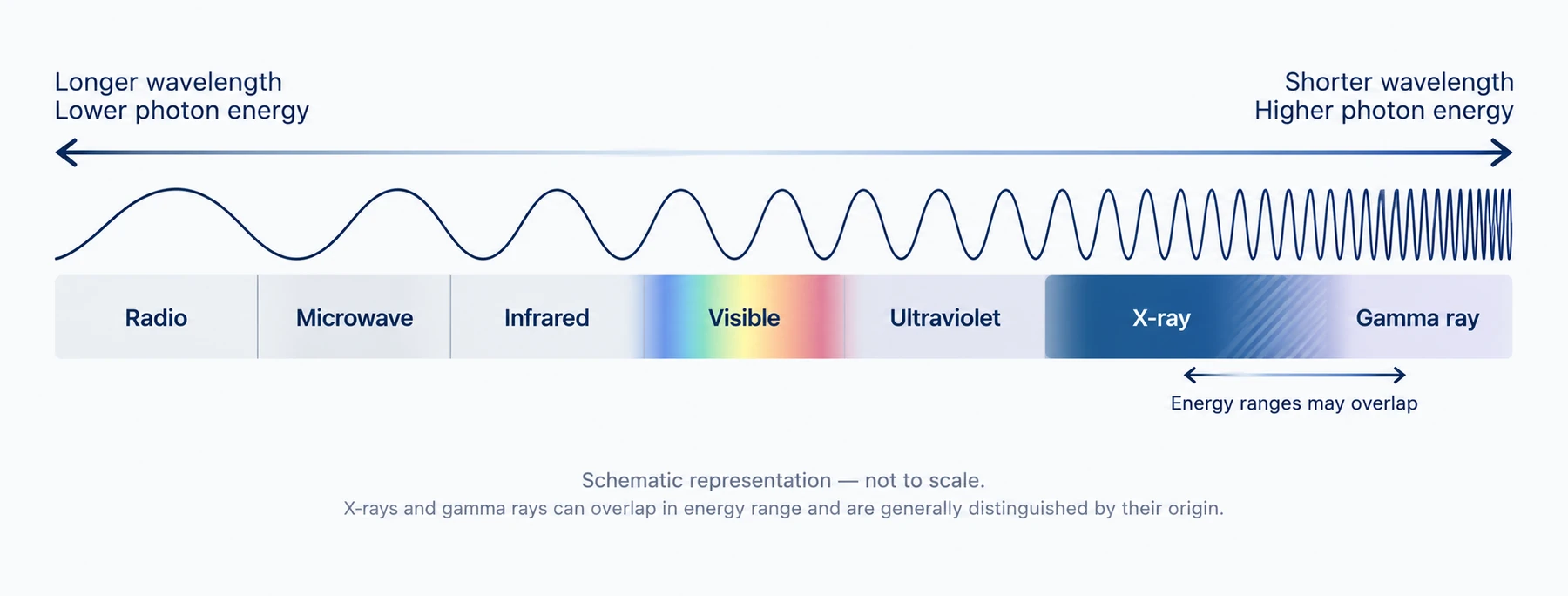
Electromagnetic radiation is divided into different regions according to wavelength, frequency, and photon energy. X-rays generally have shorter wavelengths and higher photon energies than ultraviolet radiation. The energy ranges of X-rays and gamma rays can overlap, so they are generally distinguished by their origin rather than by energy alone. X-rays are mainly produced by the deceleration of accelerated electrons or by transitions involving atomic electron shells, whereas gamma rays originate from transitions in the atomic nucleus.
As X-ray energy increases, penetration through matter generally increases. However, higher energy does not always produce a better inspection image. Actual image quality is influenced by the material and thickness of the object, X-ray generation conditions, detector characteristics, and image-processing conditions.
What happens when X-rays pass through matter?
When X-rays enter matter, some photons interact with the material and are absorbed or scattered, while others pass through it. The transmitted X-ray intensity depends on the material composition, density, thickness, and X-ray energy.
These differences in transmitted signal are a fundamental source of contrast between objects in an X-ray image. Materials of the same thickness can produce different transmitted signals, and increasing the thickness of the same material generally reduces the transmitted X-ray intensity. Actual image contrast and quality are also affected by detector characteristics and image-processing conditions.
What this means for industrial X-ray inspection
An industrial X-ray inspection system basically consists of an X-ray source, the object being inspected, and a detector. X-rays generated by the source pass through the object and reach the detector, which measures the incident X-rays and converts them into electrical signals. Data acquisition and image processing then convert differences in transmitted signal at different positions into an X-ray image.
X-ray detection performance is therefore not determined by penetration alone. Signal differences between the product and a foreign object, image noise, system geometry, object motion, and detector performance all need to be considered together.
- X-rays are a form of high-energy electromagnetic radiation classified as ionizing radiation.
- The transmitted X-ray signal varies with material composition, density, thickness, and X-ray energy.
- Signals measured by the detector are acquired as digital data and processed to form an X-ray image.
- Higher X-ray energy does not always result in a better inspection image.
- IAEA — Diagnostic Radiology Physics: A Handbook for Teachers and Students (2014).
- NIST — XCOM: Photon Cross Sections Database, Standard Reference Database 8.
- NIST — X-Ray Mass Attenuation Coefficients, Standard Reference Database 126.


