





Tube voltage and tube current
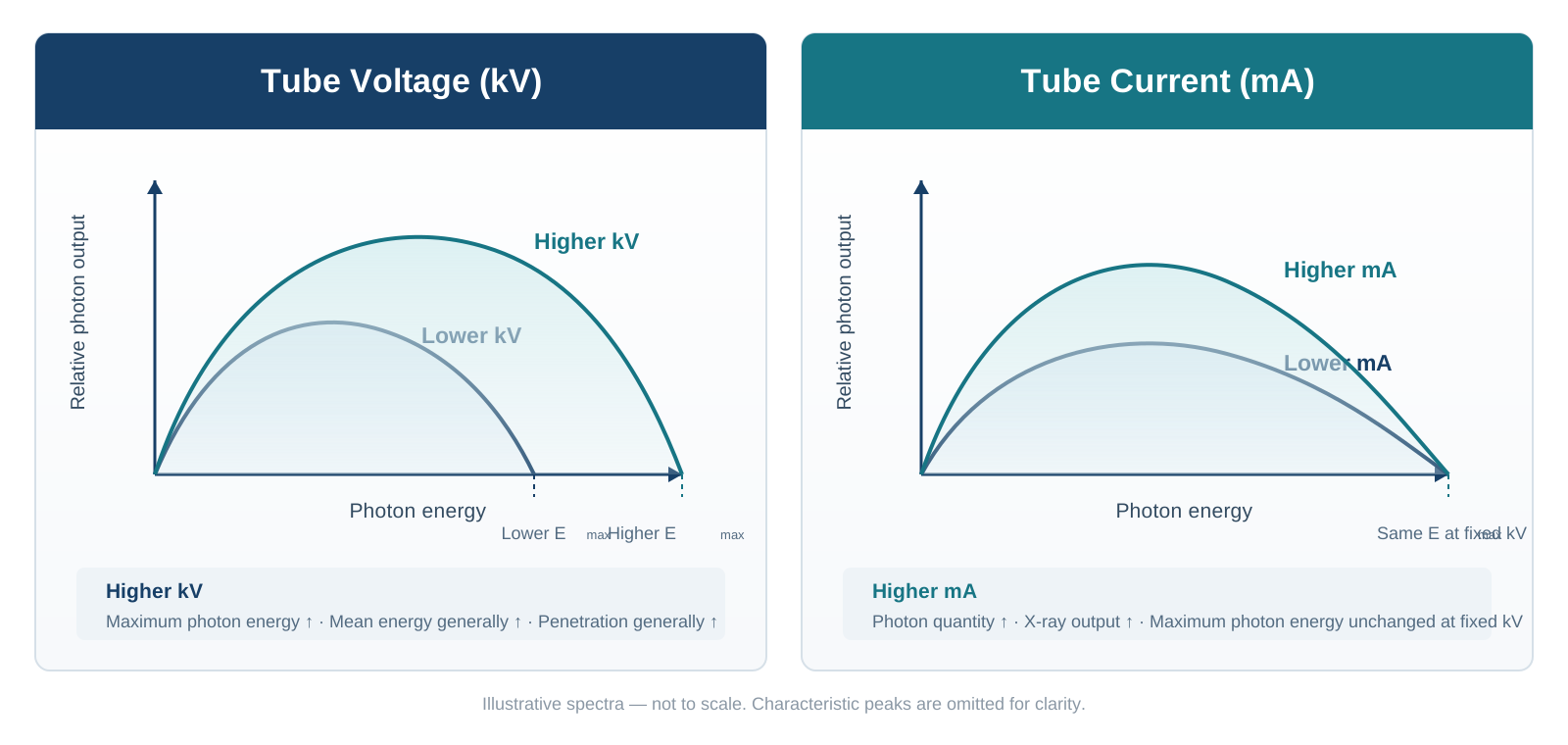
Tube voltage (kV) is the potential difference applied between the cathode and anode of an X-ray tube. This voltage accelerates electrons toward the anode and determines the maximum kinetic energy they can acquire. The maximum photon energy in the X-ray spectrum is therefore directly related to the tube voltage.
Tube current (mA) represents the flow of electrons from the cathode to the anode. At the same tube voltage, target, and filtration conditions, increasing the tube current increases the number of electrons reaching the target per unit time and therefore increases the quantity of X-rays produced.
How kV affects X-ray energy and penetration
Increasing the tube voltage raises the maximum energy available to the accelerated electrons and therefore increases the maximum photon energy of the X-ray spectrum. In an ideal relationship, a tube voltage of 100 kV corresponds to a maximum possible X-ray photon energy of 100 keV. A practical X-ray beam is not monoenergetic; it contains a continuous bremsstrahlung spectrum and may also include characteristic X-ray peaks depending on the target material and tube-voltage conditions.
As kV increases, the average photon energy and X-ray output generally increase, which increases beam penetration. However, higher kV does not always produce a better inspection image. Under conditions where the attenuation difference between the product and a foreign object becomes smaller, image contrast can decrease, so penetration and contrast must be considered together.
How mA affects X-ray quantity
When tube voltage, target, and filtration conditions are unchanged, increasing tube current generally increases X-ray output approximately in proportion to the tube current. In other words, mA mainly affects the number of photons produced per unit time and the amount of signal reaching the detector.
Increasing mA at a fixed kV does not increase the maximum X-ray photon energy. Acquiring more photons can help reduce relative statistical noise and improve SNR when photon statistics are the dominant noise source. However, excessive signal can saturate the detector, and higher tube current also increases the thermal load on the X-ray tube.
How to set kV and mA for industrial inspection
A common approach in industrial X-ray inspection is first to establish an X-ray energy setting that can adequately penetrate the product material and thickness, and then adjust the X-ray quantity so that the detector acquires a stable signal. The optimal settings, however, depend on several factors, including source filtration and irradiation geometry, the object being inspected, detector sensitivity, and dynamic range.
In conveyor-based line-detector systems, integration time directly affects the amount of X-ray signal acquired in each line. Conveyor speed and line rate also determine the sampling interval in the direction of travel and the available acquisition time, so they must be considered together. Increasing conveyor speed while maintaining the same spatial sampling may require a higher line rate, which can reduce the signal available per line. kV and mA should therefore be reviewed together with line rate, integration time, and conveyor speed rather than as independent numbers. Final settings are best determined from measurements using the actual product and target foreign objects.
- kV is the potential difference between the cathode and anode and directly affects the maximum X-ray photon energy and energy distribution.
- Increasing kV generally increases X-ray penetration and output, but it does not always increase image contrast.
- mA mainly controls the quantity of X-rays produced per unit time, and at fixed kV the output generally increases approximately in proportion to tube current.
- Increasing mA at a fixed kV does not increase the maximum X-ray photon energy.
- Practical inspection conditions should consider the object material and thickness, detector characteristics, line rate, integration time, and conveyor speed together.
- IAEA — Diagnostic Radiology Physics: A Handbook for Teachers and Students, Chapter 5: X Ray Production, Section 5.7: Factors Influencing X Ray Spectra and Output.
- U.S. FDA — Resource Manual for Compliance Test Parameters of Diagnostic X-Ray Systems. Reference for the relationship between X-ray tube potential and maximum photon energy, and between tube current and X-ray quantity / output.


