





Detectors are not classified by a single criterion
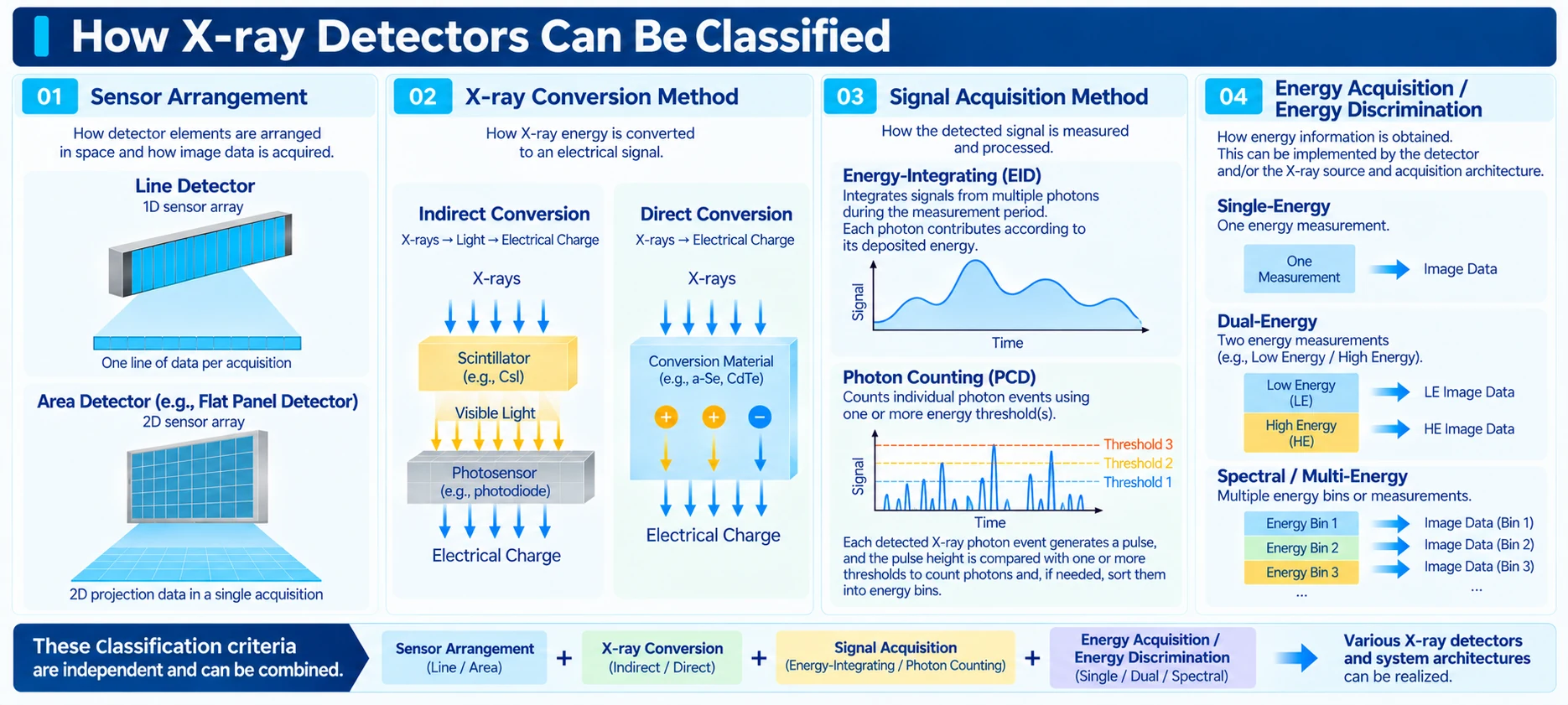
Digital X-ray detectors can be classified from several perspectives, including sensor arrangement, X-ray conversion, signal acquisition, and energy acquisition / energy discrimination.
Representative sensor arrangements include line detectors and area detectors / flat-panel detectors. X-ray conversion can be classified as indirect or direct conversion, while signal acquisition can be classified as energy-integrating or photon counting. From the perspective of energy acquisition or discrimination, terms such as single-energy, dual-energy, and spectral / multi-energy may also be used.
These classifications are not mutually exclusive. One detector, for example, may use a Line Array + Indirect Conversion + Energy-Integrating architecture, while another may use an Area Array + Direct Conversion + Photon Counting architecture.
Single-energy, dual-energy, and spectral / multi-energy operation may also be implemented through a system architecture that includes the X-ray source and acquisition method rather than being determined by the detector alone. Strictly speaking, a question such as “Line Detector or Photon Counting Detector?” therefore compares different classification criteria.
Classification by sensor arrangement — Line Detector and Area Detector
A line detector, or line detector array (LDA), is a one-dimensional detector in which sensor elements are arranged mainly along one direction. One acquisition produces one line of X-ray data. Repeatedly acquiring line data while the object moves, or while there is relative motion between the detector and object, can be used to construct a two-dimensional image.
This arrangement can be well suited to conveyor-based continuous inspection, continuous imaging of long objects, and inline inspection in which objects move in a defined direction. Final image quality, however, depends not only on the detector but also on line rate, conveyor speed, integration time, and motion synchronization.
An area detector has sensor elements arranged in a two-dimensional matrix so that X-ray information over an area can be acquired simultaneously. A common example is the flat-panel detector (FPD), in which many detector elements are arranged in rows and columns to acquire two-dimensional projection data directly.
FPDs are widely used for radiography of stationary objects or systems that acquire a projection over a defined area at once, and they can also be used in systems such as cone-beam CT that acquire projections from multiple directions.
Signal conversion — Indirect Conversion and Direct Conversion
Line / Area describes the spatial arrangement of sensors, whereas Indirect / Direct Conversion describes how X-ray energy is converted into an electrical signal.
In indirect conversion, a scintillator converts X-ray energy into visible light, and a photosensor such as a photodiode converts that light into electrical charge. A representative flow is X-rays → Scintillator → Light → Photosensor → Electrical Charge.
In direct conversion, X-rays generate electrical charge directly in a conversion material without an intermediate visible-light step. Materials such as amorphous selenium (a-Se) and CdTe-based materials can be used in direct-conversion architectures.
Line Detector / Flat Panel Detector and Indirect / Direct Conversion are therefore different classification axes and can be combined within the same detector architecture. The conversion principles themselves were discussed in 07. What Is an X-ray Detector?
How the signal is measured — Energy-Integrating and Photon Counting
Detectors can also be classified by how the detected X-ray signal is measured.
An energy-integrating detector accumulates the signal generated by multiple X-ray photons over the measurement period and produces one measured value. In general, each photon contributes to the measured signal according to the energy it deposits in the detector. This differs from photon counting, which distinguishes and counts individual photon events. Many conventional scintillator–photodiode digital X-ray detectors operate in this energy-integrating manner.
A photon-counting detector distinguishes pulses generated by individual detected X-ray photon events and counts them. In an energy-resolving photon-counting detector, the amplitude of each detected pulse can be compared with one or more energy thresholds so that photons are assigned to different energy bins.
Hybrid photon-counting detectors can use an architecture in which the sensor layer and readout electronics are optimized separately. At high photon flux, however, practical performance can be affected by count-rate capability, pulse pile-up, dead time, and related factors.
Photon counting is not the same classification axis as Line Detector or Flat Panel Detector
Line Detector / Area Detector answers the question “How are the sensors arranged spatially?” Indirect / Direct Conversion answers “How is X-ray energy converted into an electrical signal?” Energy-Integrating / Photon Counting answers “How is the generated signal measured?”
Photon-counting technology can therefore be implemented in either a line or area-array form. To understand an actual detector, it is important to consider sensor arrangement, conversion method, and signal-acquisition method together rather than looking at only one label.
Representative combinations could include Line + Indirect + Energy-Integrating, Area + (Indirect or Direct) + Energy-Integrating, and (Line or Area) + Direct + Photon Counting. These examples are not intended to list every possible architecture; they simply show that different classification axes can be combined.
Which detector is better?
No detector technology is always superior based on detector type alone. A line detector can be well suited to systems where the object moves continuously on a conveyor, while a flat-panel detector can be advantageous when acquiring a projection over an area directly or when using projections from multiple directions, as in cone-beam CT.
Photon counting can offer advantages in applications where individual photon events or energy information are important, but count-rate capability, detector material, electronics, cost, and data-processing requirements must also be considered.
Actual detector selection should therefore consider the inspection object, required spatial resolution, X-ray energy, inspection speed, signal / noise, detector geometry, and overall system architecture together. Specific specifications such as pixel pitch, dynamic range, active length, and line rate are discussed separately in 09. Understanding Key X-ray Detector Specifications.
- X-ray detectors are not classified by a single criterion.
- Line detectors and flat-panel detectors mainly describe differences in sensor arrangement.
- Indirect conversion and direct conversion classify how X-ray signals are converted.
- Energy-integrating and photon counting classify how the detected signal is measured.
- Single-energy, dual-energy, and spectral / multi-energy operation can be related to the overall system architecture, including the source and acquisition method, rather than to the detector alone.
- A photon-counting detector can use either a line or area architecture, so comparing Line / FPD / Photon Counting as one classification axis can be misleading.
- Actual detector selection should consider the inspection method and complete system conditions rather than detector type alone.
- IAEA — Quality Assurance Programme for Digital Mammography, IAEA Human Health Series No. 17. Reference for flat-panel indirect / direct detectors and slot-scanning photon-counting detector architectures.
- IAEA — Guidelines on Training, Examination and Certification in Digital Industrial Radiography, Training Course Series No. 60. Reference for the distinction between DDA (Flat Panel Detector) and LDA (Line Detector Array).
- NIST — Using a 4-Megapixel Hybrid Photon Counting Detector for Fast, Laboratory-Based Nanoscale X-Ray Tomography. Reference for X-ray imaging applications of hybrid photon-counting detectors.


