





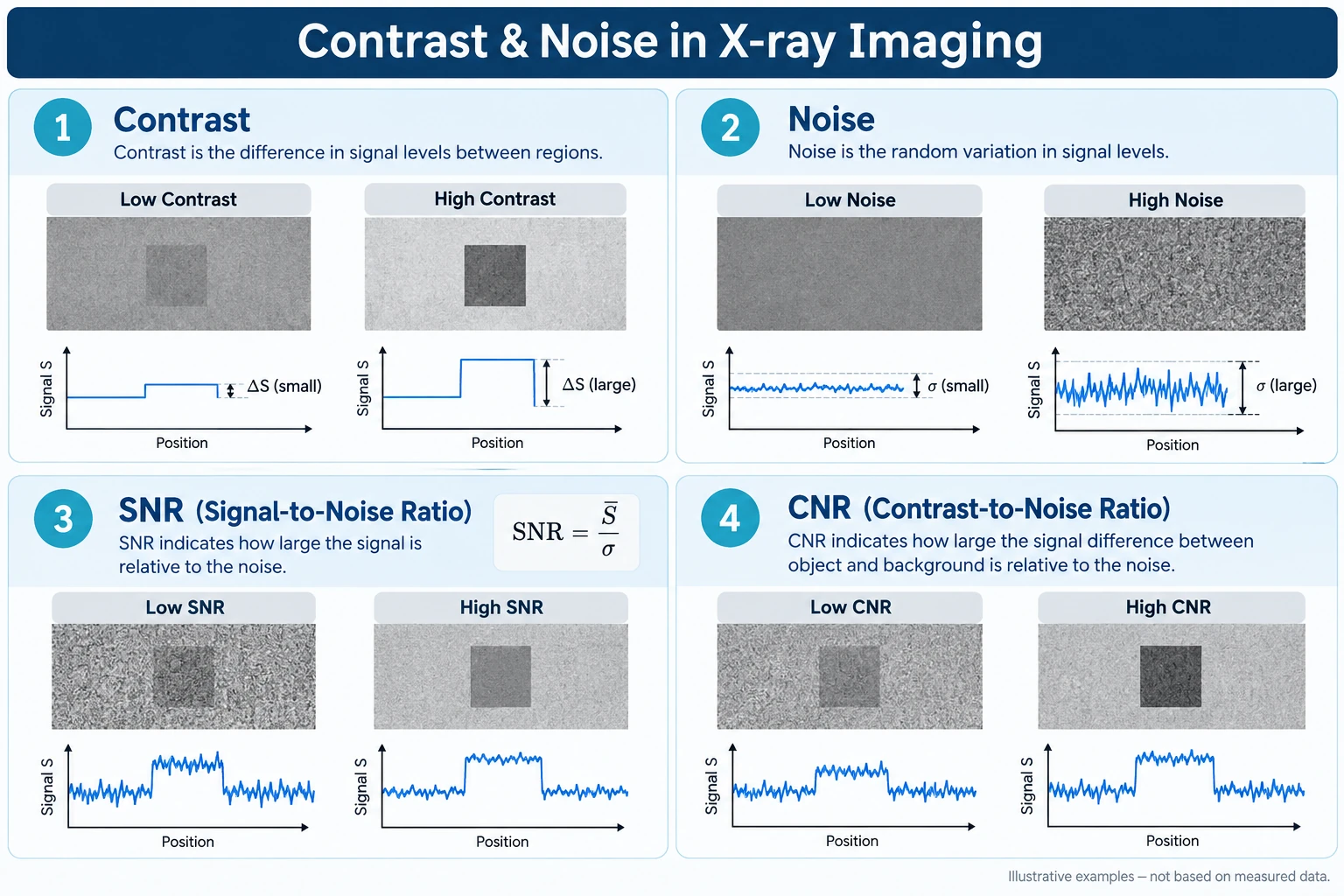
Contrast represents the signal difference between regions
Contrast in an X-ray image refers to the difference in measured signal level between different regions. In transmission X-ray inspection, attenuation changes with material composition, density, and thickness, and these attenuation differences are a fundamental cause of differences in transmitted signal reaching the detector.
Detector calibration is used to correct pixel-to-pixel offset, gain, and non-uniform response. The contrast seen on the final display can also change with display mapping such as normalization, window / level settings, tone mapping, and other image processing. It is therefore important to distinguish the physical difference in transmitted signal from detector correction and final displayed contrast.
Noise is irregular variation in the signal
Noise refers to variation in pixel values around an average even under the same conditions or within a uniform region. Major contributors in X-ray imaging can include quantum noise caused by a limited number of detected photons and electronic noise generated by the detector and readout electronics.
The standard deviation (σ) of pixel values within an ROI is often used as a simple measure of noise in a uniform region. A practical detector, however, can also exhibit pixel-response variation, structured noise, image-processing effects, and spatial correlation, so a single standard-deviation value cannot describe every aspect of noise.
SNR describes signal relative to noise
SNR (Signal-to-Noise Ratio) indicates how large the signal is relative to the noise. For an ROI with a uniform positive signal, a simplified form can be written as SNR = S̄ / σ, where S̄ is the mean signal value in the ROI and σ is the standard deviation of the pixel values in that region.
This expression is a simple way to evaluate SNR in a uniform and appropriately corrected image. In a practical imaging system, the evaluation method can vary depending on spatial noise correlation, detector characteristics, and image processing.
When quantum noise is dominant, increasing the number of detected X-ray photons reduces the relative statistical fluctuation and can improve SNR. Under ideal Poisson statistics, quantum-limited SNR is proportional to the square root of the number of detected photons.
CNR evaluates the difference between two regions relative to noise
CNR (Contrast-to-Noise Ratio) evaluates the signal difference between an object and background relative to the noise level. The exact expression can vary with the evaluation purpose and measurement method. One common form is CNR = |S̄object − S̄background| / σbackground.
Here, S̄object and S̄background are the mean signal values of the object and background ROIs, and σbackground is the standard deviation representing noise in the background region. Some definitions use a combined noise value from both ROIs in the denominator, so the definition and measurement conditions should be checked when comparing CNR values.
The key question is whether the signal difference between the object and background is sufficiently large relative to the noise. A higher CNR generally makes small attenuation differences easier to distinguish, although actual detectability is also influenced by spatial resolution and sampling conditions.
Industrial X-ray inspection requires contrast and noise to be considered together
In an industrial X-ray line-detector system, tube voltage, tube current, integration time, line rate, object attenuation, detector efficiency, pixel pitch, scintillator characteristics, and readout noise can all influence image contrast and noise.
Acquiring more X-ray signal can improve SNR when quantum noise is dominant. However, for some material combinations, increasing X-ray energy can reduce attenuation differences between materials and lower subject contrast. The goal therefore cannot simply be the highest energy or the largest signal.
Visibility of small foreign objects or fine structures is also influenced by spatial resolution and sampling in the direction of motion, not by CNR alone. Practical inspection therefore requires a balance among CNR, spatial resolution, and signal level that matches the object and system conditions rather than maximizing contrast or SNR in isolation.
- Contrast represents the signal difference between regions, and the physical transmitted-signal difference should be distinguished from final displayed contrast.
- Noise is irregular signal variation that can occur even in a uniform region, with contributions such as quantum noise and electronic noise.
- SNR describes signal relative to noise and can be evaluated simply from the ratio of mean signal to standard deviation in a uniform ROI.
- CNR evaluates the signal difference between an object and background relative to noise, and the calculation method can vary with the measurement purpose.
- Practical X-ray image visibility is affected by contrast, noise, spatial resolution, sampling, calibration, and image-processing conditions together.
- IAEA — Diagnostic Radiology Physics: A Handbook for Teachers and Students, Chapter 4: Image Quality.
- IAEA — Design, Development and Optimization of a Low Cost System for Digital Industrial Radiology, Radiation Technology Reports No. 2.


