





What are attenuation and transmission?
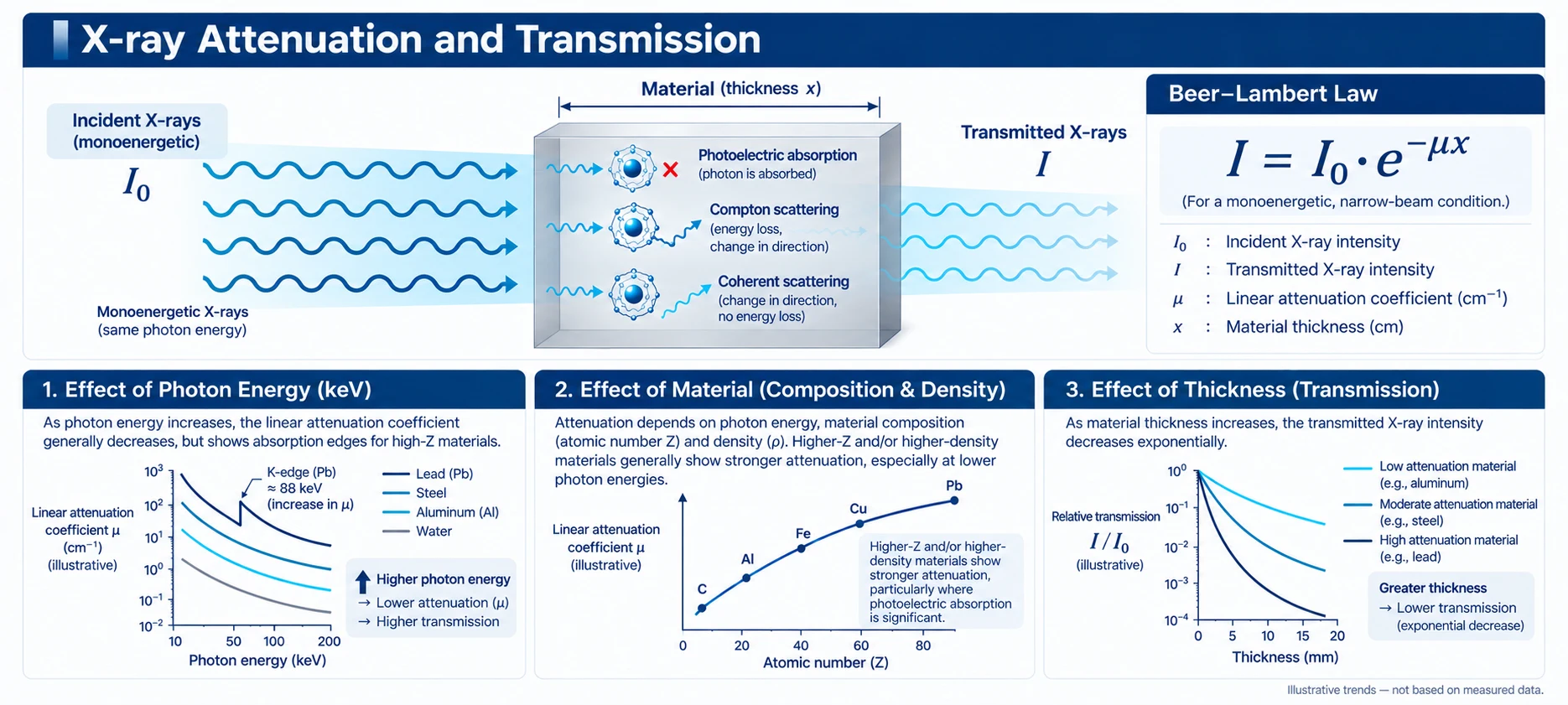
When an X-ray beam passes through matter, some photons interact with the material and are absorbed or scattered away from their original direction. The reduction in the number or intensity of primary X-rays traveling in the original direction is called attenuation.
Primary X-rays that pass through without interacting form the transmitted component. As a result, different materials or thicknesses can produce different transmitted signals at the detector even under the same incident X-ray conditions. In a real inspection system, some scattered X-rays can also reach the detector, so the measured signal may not consist only of the primary transmitted component.
Beer–Lambert law and attenuation coefficient
Under ideal conditions in which a narrow monoenergetic X-ray beam passes through a uniform material and scattered radiation reaching the detector can be neglected, the intensity of the remaining primary X-rays decreases exponentially with thickness. This relationship is described by the Beer–Lambert law as I = I₀ exp(−μx).
Here, I₀ is the incident X-ray intensity, I is the primary X-ray intensity after passing through thickness x, and μ is the linear attenuation coefficient. A larger μ means that X-rays are attenuated more rapidly over the same thickness. Because the linear attenuation coefficient is affected by material density, the mass attenuation coefficient (μ/ρ), which normalizes μ by density, is also widely used when comparing basic material data.
What determines X-ray attenuation?
X-ray attenuation is not determined by a single factor. Photon energy, elemental composition, density, and thickness all contribute. For the same material, increasing thickness reduces the primary transmitted X-ray signal. At the same thickness, different materials can produce different amounts of attenuation.
The total attenuation coefficient represents the combined effects of several interactions between X-rays and matter. NIST XCOM provides partial interaction coefficients and total attenuation coefficients for processes including coherent scattering, incoherent (Compton) scattering, and photoelectric absorption as functions of photon energy and material. The relative contribution of each interaction changes with energy and material composition.
What this means for industrial X-ray inspection
Industrial X-ray inspection uses differences in transmitted signal at different positions to image internal product structure and foreign objects. A region that attenuates X-rays more strongly than the surrounding product reduces the primary signal reaching the detector, and this difference is an important source of image contrast. Final image brightness and contrast, however, are also affected by detector response, scatter, calibration, and image processing.
A practical X-ray tube produces a continuous spectrum containing photons with many different energies rather than a single energy. Because the attenuation coefficient depends on photon energy, lower-energy components can be removed more strongly as the beam passes through matter, changing the energy distribution of the beam. This beam-hardening effect means that a single μ value cannot completely describe every practical transmission condition. Source conditions, product thickness, and detector response therefore need to be considered together.
- X-ray attenuation is the reduction of primary X-rays traveling in the original direction due to interactions such as absorption and scattering.
- Under ideal narrow-beam, monoenergetic conditions, primary transmitted X-ray intensity decreases exponentially with thickness according to the Beer–Lambert law.
- The linear attenuation coefficient μ depends on photon energy and material properties, while the mass attenuation coefficient μ/ρ is used to compare materials after normalizing for density.
- For the same material, increasing thickness reduces transmitted signal; at the same thickness, different materials can produce different attenuation.
- Practical industrial X-ray beams are polyenergetic, so beam hardening, scatter, and detector response must also be considered.
- IAEA — Diagnostic Radiology Physics: A Handbook for Teachers and Students, Chapter 2: Interactions of Radiation with Matter, Sections 2.3.1–2.3.3.
- NIST — XCOM: Photon Cross Sections Database, Standard Reference Database 8.
- NIST — X-Ray Mass Attenuation Coefficients, Standard Reference Database 126.


